Showing posts with label console. Show all posts

Monday, September 20, 2010

10 Fresh Ideas Saving Gaming A counterpoint to our 'Stale Ideas' feature. Sunshine, lollipops and rainbows!

It's not all doom and gloom, you know – there's a lot to love and be proud of within our favoured pastime. As something of a counterpoint to our '10 Stale Ideas Holding Back Gaming' feature, we're taking a look at 10 concepts and techniques that are pushing the industry forward – both from a creative standpoint and an economic one. Hopefully, when viewed in tandem, these features will help paint a fuller picture of the wider industry and your place as a gamer within it.

What are your favourite fresh trends in gaming? Sound off in the IGN forums!


Cloud Computing 
If there's a certain old-thinking, dusty approach to game design that has seemingly taken root in the games development sphere – and believe us, there is to a large extent, then here before you is an answer of sorts. It's an approach to games design that not only fixes artificial intelligence by giving that design element to players, but it also takes a leap off the back of user-generated content. We're talking about cloud computing; a method of networking gaming systems and PCs to a central database, continuously expanding and collating data – and then feeding that data back into the game world, improving and building on the experience. It's a nebulous term that could have a massive and rock-solid impact on how games are designed and, importantly, grow with the player. 

Social Integration 
At first glance, the uptake of social networking might seem perfunctory – I mean, you can't toss a stone without hitting reference to Facebook, Twitter or MySpace. But the real beauty of this trend actually rests in new ways of experiencing and sharing games. Titles like Farmville actually bred a thoughtful approach to mainstream-oriented multiplayer games. It also spreads gaming as a pastime beyond living rooms and into the public psyche in ways that not even Nintendo has quite managed to do. If developers can continue to leverage social gaming elements into software in interesting and (critically) unobtrusive or invasive ways, it'll ultimately bring a fresh audience to gaming –and fresh ideas to boot. 

The shift towards large-scale gaming productions on handhelds will dramatically increase in line with hardware power and market penetration. (Hehe. Penetration.)

Handhelds as Lead Platforms 
Here's a novel trend - and one that points towards gaming's increasingly mobile and flexible future. As hardware is prepped for the next round of handheld consoles from Nintendo and Sony (and Apple continue to ride the successes of iPhone/Pod/Pad), we're starting to see major franchises opting for a handheld environment as lead, rather than main-line consoles. Dragon Quest IX is a great case-in-point of Square Enix reading the market penetration of the DS – and crafting an excellent adventure to suit the hardware. Expect more games developers to look to handhelds first; the development costs are lower and the install base for these platforms make them very viable for generating major sales. 

Graphic Minimalism 
It's no accident that we're seeing a resurgence in 2D and highly stylized games engines starting to emerge. While there will always be a large portion of the market that appreciates the latest graphical advances and incremental physics improvements, there's a class of player out there who simply doesn't give a hoot. The reasoning is simple enough to understand; games are the culmination of gameplay, objectives and a presentation to support that core gameplay. Everything else is just a spit-polish over the top. Expect to see a gradual increase in pixel-art, chip-tunes and minimalism. Plus – it's less resource-hungry at the development end and it emphasises the importance of overall art direction – not just texture resolution and hardware grunt. 

Investing in Your Wii Development Team 
Now that PlayStation Move is in the market and developers are used to dealing in the motion-control space, we're expecting a return to higher-quality motion control games on Wii. This might seem obvious, but if your development team's skills aren't up to scratch, chances are the final game won't be all that crash-hot either. These days, however, we're starting to see major investment in Wii titles from major developers – and the results speak for themselves. Metroid: Other M, the Wii iteration of Silent Hill: Shattered Memories and a number of upcoming titles from Square Enix and Capcom show what the system is capable of in the right hands. Unfortunately, with the exception of Nintendo's core franchises, even the first-party developer itself rarely pushes its own hardware in interesting ways. Here's hoping for change. 

Pushing Boundaries 
Take a risk. Just because your title doesn't immediately scream 'commercial hit' doesn't damn it, either. There are numerous cases every year of independent developers and small team creations breaking through to serious commercial successes off the back of a great idea and air-tight gameplay. It happens. It's no accident. While a large marketing budget can sometimes (often, in fact) smooth over critical gameplay flaws at the cash register, a truly great game with broad appeal can ultimately score true critical and commercial success. 

Focusing in on What Works 
We're seeing games starting re-emerge that are slightly more focussed – or even single-minded about their approach to gameplay. By keeping a concept simple – and getting the core gameplay right, games tend to excel within its genre. That leads to better reception by fans of the genre and, in turn, grassroots praise and – in theory – better sales. Games like Limbo, Flower and even more complex commercial efforts like Left 4 Dead tend towards greater successes by nailing its core gameplay concepts rather than watering the experience down with too many extraneous ideas. 

Story? Who needs it! (Answer: Square Enix, Bethesda, Bioware and developers of that ilk.)

Telling a Good Story (But Only When It's Needed) 
Storytelling is an art form –and games, too, are artful in their own right. However, just because your game aims to convey a story doesn't necessarily mean you're going to tell it well. Games, by their length and structure, rarely cater to a Hollywood-standard narrative arc. Therefore, it's all the more critical that developers continue to take care when crafting a storyline; opting for quality writing and ensuring that the game actually calls for a story in the first place. Case in point? The storytelling process in Mario Galaxy 2 versus the arbitrary one in New Super Mario Bros. Wii. Nintendo knows the focus in NSMB Wii is the purity of gameplay, while reserving Galaxy for more cinematic storytelling. 

Evolving Worlds 
Looking at a game like LittleBigPlanet, which so slickly combines deep customization functionality with an online infrastructure that gives players access to a multitude of unique player-created gaming experiences, we see the earliest footsteps towards cloud game expansion. What we hope is, as players use the tools in front of them, the game itself begins to compile data on how players are using items and, in turn, what is being built. That data could be used in a massive variety of ways - including evolving and highly customisable game worlds. 

The Rise of Digital Distribution 
As a counterpoint to the broken retail model that currently plagues games developers and publishers alike (whereby retailers encourage used games sales over new purchases in order to up the profit margin), self-publishing and digital distribution platforms have been increasing in prevalence and relevance over the last year or so. As the market has cottoned onto the value and viability of inexpensive 'app store' apps and a mainstream pricing model, we think this is pointing the way forward for games distribution and sales in the future. 
Metal Gear Solid Snake Eater 3DS
    

Saturday, September 18, 2010

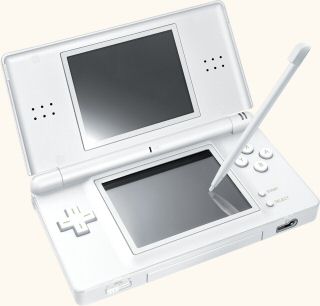
Nintendo DS


The Nintendo DS is the most recent handheld system developed by Nintendo. It was released in 2004 and was the first handheld system to feature dual screens. In improved edition called the DS Lite was released in 2006. The term "Lite" refers to it having brighter screens, smaller size and lower weight, it still has the same features as the original.

Specs:
  • Two backlit 3-inch TFT color LCDs with 256x192 pixel resolution
  • Lower screen is a touch screen
  • Color: Capable of displaying 260,000 colors
  • Wireless Communication: IEEE 802.11 and Nintendo's proprietary format
  • Multiple users can play multiplayer games using just one DS game card
  • Controls: Touch screen, embedded microphone for voice recognition, A/B/X/Y face buttons, plus control pad, L/R shoulder buttons, Start and Select buttons
  • Input/Output: Ports for both Nintendo DS game cards and Game Boy Advance Game packs, terminals for stereo headphones and microphone
  • Other Features: Embedded PictoChat software that allows up to 16 users to chat at once; embedded real-time clock; date, time and alarm; touch-screen calibration
  • CPUs: One ARM9 and one ARM7
  • Sound: Stereo speakers providing virtual surround sound, depending on the software
  • Battery: Lithium ion battery delivering six to 10 hours of play on a four-hour charge, depending on use; power-saving sleep mode; AC adapter
  • Languages: English, Japanese, Spanish, French, German, Italian
  • Available colors: various, depending on region

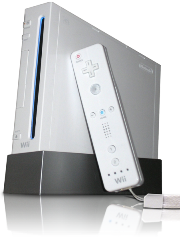
Nintendo Wii


The Wii is a home video game console released by Nintendo at 2006. It's the primary competitor of Microsoft's Xbox 360 and Sony's PlayStation 3. 

Specs:
  • CPU: PowerPC-based
  • GPU: ATI "Hollywood" GPU.
  • Memory: 88 MB main memory and 3 MB embedded GPU texture memory and framebuffer.
  • Storage: 512 MB built-in NAND flash. SD card memory slot (up to 2 GB). Nintendo GameCube Memory Card (required for GameCube game saves). Slot-loading disc drive compatible with 8 cm Nintendo GameCube Game Disc and 12 cm Wii Optical Disc.
  • Video: 480p (PAL/NTSC), 480i (NTSC) or 576i (PAL/SECAM), standard 4:3 and 16:9 anamorphic widescreen[88]. MultiAV multi-output port for component, composite, S-video,[89] RGB SCART[90] and VGA[91].
  • Audio: Stereo – Dolby Pro Logic II-capable[92]. Built-in speaker in controller.
  • Additional: 2 USB ports, WIFI capabilities and Bluetooth.

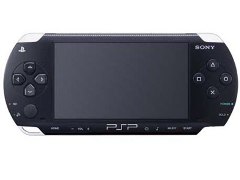
PlayStation portable


The PlayStation Portable, PSP for short, is a handheld game console created by SONY and released at December 12, 2004(Japan).

The PSP's goal is to be a complete entertainment platform since it is able to run video games, play video content, digital audio and display digital photos stored in memory sticks or UMD disks.

PSP Specifications
  • Product Name: PlayStation Portable (PSP)
  • Color: Black
  • Dimensions: Approx. 170 mm (L) x 74 mm (W) x 23 mm (D)
  • Weight: Approx. 260 g (including battery)
  • CPU: PSP CPU (System clock frequency 1~333MHz)
  • Main Memory: 32MB
  • Embedded DRAM: 4MB
  • Display: 4.3 inch, 16:9 widescreen TFT LCD, 480 x 272 pixel (16.77 million colors), Max. 200 cd/m2 (with brightness control)
  • Speakers: Built-in stereo speakers
  • Main Input/Output: IEEE 802.11b (Wi-Fi), USB 2.0 (Target), Memory Stickâ„¢ PRO Duo, IrDA, IR Remote (SIRCS)
  • Disc Drive: UMD Drive (Playback only)
  • Profile: PSP Game, UMD Audio, UMD Video
  • Main Connectors: DC OUT 5V, Terminals for charging built-in battery, Headphone/Microphone/Control connector
  • Keys/Switches: Directional buttons (Up/Down/Right/Left)Analog pad, Enter keys (Triangle, Circle, Cross, Square), Left, Right keys START, SELECT, HOME, POWER On/Hold/Off switch, Brightness control, Sound Mode, Volume +/-, Wireless LAN On/Off switch, UMD Eject
  • Power: Built-in lithium-ion battery, AC adaptor
  • Access Control: Region Code, Parental Control
  • Accessories: Stand, Headphone with remote commander, Headphone with remote commander and microphone, External battery pack, Case, Strap
UMD Specifications
  • Dimensions: Approx. 65 mm (W) x 64 mm (D) x 4.2 mm (H)
  • Weight: Approx. 10g
  • Disc Diameter: 60 mm
  • Maximum Capacity: 1.8GB (Single-sided, dual layer)
  • Laser wavelength: 660nm (Red laser)
  • Encryption: AES 128bit
  • Profile: PSP Game (full function), UMD Audio (codec ATRAC3plusâ„¢, PCM, (MPEG4 AVC)), UMD Video (codec MPEG4 AVC, ATRAC3plusâ„¢, Caption PNG)

Console Playstation 3


"PS3" redirects here. For other uses, see PS3

The PlayStation 3 (officially abbreviated as PS3) is the third home video game console produced by Sony Computer Entertainment, and the successor to the PlayStation 2 as part of the PlayStation series. The PlayStation 3 competes with Microsoft's Xbox 360 and Nintendo's Wii as part of the seventh generation of video game consoles.
A major feature that distinguishes the PlayStation 3 from its predecessors is its unified online gaming service, the PlayStation Network, which contrasts with Sony's former policy of relying on video game developers for online play. Other major features of the console include its robust multimedia capabilities, connectivity with the PlayStation Portable, and its use of a high-definition optical disc format, Blu-ray Disc, as its primary storage medium. The PS3 was also the first Blu-ray 2.0-compliant Blu-ray player on the market.
The PlayStation 3 was first released on November 11, 2006 in Japan,[14] November 17, 2006 in NorthAmerica and South America and March 23, 2007 in Europe and Oceania. Two SKUs were available at launch: a basic model with a 20 GB hard drive (HDD), and a premium model with a 60 GB hard drive and several additional features (the 20 GB model was not released in Europe or Oceania). Since then, several revisions have been made to the console's available models, most notably with the release of a new slim model in September 2009 to coincide with rebranding of the console and its logo.


(Counter-clockwise from top) Original logo, new logo, original model, controller, newer slim model design.
Developer SCEI
Manufacturer Sony EMCS, Foxconn, Lanix, ASUSTeK
Product family PlayStation
Type Video game console
Generation Seventh generation era
Retail availability November 11, 2006
(details)
Units sold 33.5 million (as of December 31, 2009)
Media
Blu-ray Disc (PlayStation 3 game disc)
DVD
Compact Disc
PlayStation game disc
PlayStation 2 game disc (1st & 2nd generations only)
Super Audio CD (1st & 2nd generations only)
Digital distribution
Operating system XrossMediaBar
system software version 3.30
CPU 3.2 GHz Cell Broadband Engine with 1 PPE & 7 SPEs
Storage capacity 2.5" SATA hard drive
(20 GB, 40 GB, 60 GB, 80 GB, 120 GB, 160 GB, or 250 GB included) (upgradeable)
Memory 256 MB system and 256 MB video
Display
Composite video (480i/576i)
S-Video (480i/576i)
RGB SCART (480i/576i)
Component (YPbPr) (up to 1080p)
D-Terminal (D5) (up to 1080p)
HDMI (up to 1080p)
Graphics 550 MHz NVIDIA/SCEI RSX 'Reality Synthesizer'
Sound
Audio output formats
Controller input Sixaxis, DualShock 3, Logitech Driving Force GT, Logitech Cordless Precision™ controller, standard USB controllers, GT Force, Rhythm game controllers, PlayStation Move, GunCon 3, PlayStation Portable, Keyboard and Mouse
Connectivity
Online services PlayStation Network
Backward
compatibility PlayStation (all models)
PlayStation 2 (20 GB, 60 GB, and some (CECHExx) 80 GB models)
Predecessor PlayStation 2

console XBOX 360

For this next-generation Xbox, Microsoft is not just building a great gaming system, but also a great entertainment platform. 

One of the things that excites me the most about the Xbox 360 is its advanced hardware specs. Yes, yes, I know, Microsoft says that “in the HD Era the platform is bigger than the processor” and I agree with that, but I can’t help thinking about the things that this hardware will be able to pull off. 

The Xbox 360 represents a technological breakthrough only possible because of the hard work of hundreds of masterminds around the world who converged to create the ultimate gaming machine. Unreal Engine 3-powered games running at 1280x720 with full screen anti-aliasing? Not a problem for the Xbox 360. 

Be sure to check out the full complement of our Xbox 360 coverage right here: 

Xbox 360: Pulling Back the Curtain – the story behind Microsoft’s upcoming console.
Xbox 360 Dissected – all the official specifications and other techno-speak.
The Xbox 360 Software and Services Features – a quick reference table of Xbox Live and more. 


Хboх 360 System Performance - Draft
Custom IBM PowerPC-based CPU
  • 3 symmetrical cores running at 3.2 GHz each
  • 2 hardware threads per core; 6 hardware threads total
  • 1 VMX-128 vector unit per core; 3 total
  • 128 VMX-128 registers per hardware thread
  • 1 MB L2 cache
CPU Game Math Performance

  • 9 billion dot product operations per second
Custom ATI Graphics Processor

  • 500 MHz
  • 10 MB embedded DRAM
  • 48-way parallel floating-point dynamically-scheduled shader pipelines
  • Unified shader architecture
Polygon Performance

  • 500 million triangles per second
Pixel Fill Rate

  • 16 gigasamples per second fillrate using 4X MSAA
Shader Performance

  • 48 billion shader operations per second
Memory

  • 512 MB GDDR3 RAM
  • 700 MHz DDR
  • Unified memory architecture
Memory Bandwidth

  • 22.4 GB/s memory interface bus bandwidth
  • 256 GB/s memory bandwidth to EDRAM
  • 21.6 GB/s front-side bus
Overall System Floating-Point Performance

  • 1 TFLOP
Storage

  • Detachable and upgradeable 20 GB hard drive
  • 12X dual-layer DVD-ROM
  • Memory unit support starting at 64 MB
I/O

  • Support for up to 4 wireless game controllers
  • 3 USB 2.0 ports
  • 2 memory unit slots
Optimized for Online

  • Instant, out-of-the-box access to Xbox Live features, including Xbox Live Marketplace for downloadable content, Gamer Profile for digital identity and voice chat to talk to friends while playing games, watching movies or listening to music
  • Built in Ethernet Port
  • Wi-Fi Ready: 802.11 A, B and G
  • Video Camera Ready
Digital Media Support

  • Support for DVD-Video, DVD-ROM, DVD-R/RW, DVD+R/RW, CD-DA, CD-ROM, CD-R, CD-RW, WMA CD, MP3 CD, JPEG Photo CD
  • Stream media from portable music devices, digital cameras, Windows XP PCs
  • Rip music to Xbox 360 hard drive
  • Custom playlists in every game
  • Windows Media Center Extender built in
  • Interactive, full screen 3D visualizers
HD Game Support

  • All games supported at 16:9, 720p and 1080i, anti-aliasing
  • Standard definition and high definition video output supported
Audio

  • Multichannel surround sound output
  • Supports 48 KHz 16-bit audio
  • 320 independent decompression channels
  • 32-bit audio processing
  • Over 256 audio channels
System Orientation

  • Stands vertically or horizontally
Customizable Face Plates

  • Interchangeable to personalize the console


Key Highlights 

Hardware, software, and services: Unveiled to the world on MTV on Thursday, May 12, 2005, Xbox 360 represents a dramatic leap forward in high-definition gaming and entertainment experiences. Fusing powerful hardware, software, and services, Xbox 360 fully engages you in a gaming experience that is more expansive, dramatic, and lifelike, where the possibilities are limitless and your imagination knows no boundaries. The next generation is here. 

Industrial design: A merger of form and function, Xbox 360 wraps powerful technology in a sophisticated exterior. Two of the most innovative design firms in the world—San Francisco-based Astro Studios and Osaka, Japan-based Hers Experimental Design Laboratory Inc.—came together to craft a sleek, stylish system that conveys the very essence of Xbox 360. 

Xbox Gamer Guide: The Xbox Gamer Guide is an entertainment gateway that instantly connects you to your games, friends, music, movies, and downloadable content. Available at a touch of the Xbox Guide Button, the Xbox Gamer Guide gives you instant access to the experiences and content you want, from the gamer card of the player that just invited you to play online to new downloadable content for the game currently running. 

Personalized interface: Xbox 360 lets you create your own unique system and experience. With interchangeable Xbox 360 Faces, it's easy and fun to change the appearance of your console. Switch on your system and customize the look and feel of the Xbox Gamer Guide and Xbox System Guide with unique "skins." From sleek and sophisticated to fun and funky, pick the Faces and skins that show your personality. 

Ring of Light and Xbox Guide Button: Divided into four quadrants, the glowing Ring of Light and Xbox Guide Button visually connect you to your games, digital media, and the world of Xbox Live, the first global, unified online console games service. Featured on both the wireless and wired controllers, the Xbox Guide Button puts you in control of your experience. In addition to bringing up the Xbox Gamer Guide and the Xbox System Guide, the Xbox Guide Button lets you turn the system on and off without ever leaving the couch. 

Xbox Live: Xbox Live is where games and entertainment come alive, the only unified place where you can play with anyone, anytime, anywhere. And the best just got better. Connect your Xbox 360 to your broadband connection and get instant access to Xbox Live Silver. Express your digital identity through your Gamertag and gamer card, talk with others using voice chat, and access Xbox Live Marketplace—all right out of the box, at no extra cost. Upgrade to Xbox Live Gold and enter the exciting world of multiplayer online gaming. With intelligent matchmaking, access to all your achievements and statistics, video chat and video messaging, and an enormous selection of games, Xbox Live Gold delivers your competition, on your terms. 

Xbox Live Marketplace: Keep your favorite games fresh with instant access to new content. Xbox Live Marketplace is a one-stop shop to download new game trailers, demos, and episodic content, plus new game levels, maps, weapons, vehicles, skins, and more. Accessible to everyone who establishes a broadband connection with their Xbox 360, Xbox Live Marketplace lets you personalize and extend your experience, on demand. 

Games: Xbox 360 redefines what games look like, sound like, feel like, and play like to engage you like never before. With Xbox 360, epic worlds are alive with detail, from thunderous skies rumbling over a mountain range to tiny blades of grass rustling together in the breeze. Vibrant characters display depth of emotion to evoke more dramatic responses, immersing you in the experience like never before. You’ll see all Xbox 360 titles at 720p and 1080i resolution in 16:9 widescreen, with anti-aliasing for smooth, movie-like graphics and multi-channel surround sound. 

Digital entertainment: Amplify your music, photos, video, and TV. Watch progressive-scan DVD movies right out of the box. Rip music to the Xbox 360 hard drive and share your latest digital pictures with friends. Make the connection, and Xbox 360 instantly streams the digital media stored on your MP3 player, digital camera, Media Center PC, or any Microsoft Windows XP-based PC.


Your Ad Here